Monday, July 20, 2009

An engaging family-friendly vision of the future

When I was around 11-15 years old, I devoured almost all the science fiction books in the local village library. The experience not only inspired me and stretched my imagination, but pre-disposed me to be open-minded about possible large impacts by technology on how life would be lived in the future.

Much of the technology that will have the biggest impact on the 21st century remains as yet undiscovered. Some of these discoveries will, presumably, be made by people who are currently still children. My hope is that these children will take interest in the kinds of ideas that permeate Shannon Vyff’s fine book “21st century kids: a trip from the future to you”.

The majority of the action in this book is set 180 years in the future – although there are several loop-backs to the present day. Here are just a few of the themes that are woven together in this fast-moving book:
  • Cryonic suspension, and the problems of eventual re-animation;
  • Brain implants, that enable a kind of telepathic communication;
  • Implications if human brains and human bodies could be dramatically improved;
  • Options for improving the brains of other animal species, even to the point of enabling rich communications between these creatures and humans;
  • Humans co-existing with self-aware robots and other AIs;
  • Friendly versus unfriendly AI;
  • Transferring human consciousness into robots (and back again);
  • Coping with the drawbacks of environmental degradation;
  • Future modes of manufacturing, transport, recreation, education, and religion;
  • Circumstances in which alien civilisations might take an active interest in developments on the Earth.
Adults can enjoy reading “21st century kids”, but there are parts of the book that speak more directly to children as the primary intended readership. Since I’ve long left my own adolescent days behind, I’m not able to fully judge the likely reactions of that target audience. My expectation is that many of them will find the contents engaging, thought-provoking, and exciting. It’s family-friendly throughout.
One unusual aspect of the book is that several of the main characters have the same names (and early life histories) as three of the author’s own children: Avianna, Avryn, and Avalyse. The author herself features in the book, as the (unnamed) “Mom”. I found this occasionally unsettling, but it adds to the book’s vividness and immediacy.

As regards the vision the book paints of the future, it’s certainly possible to take issue with some of the details. However, the bigger picture is that the book is sufficiently interesting that it is highly likely to provoke a lot of valuable debate and discussion. Hopefully it will stretch the imagination of many potential future technologists and engineers, and inspire them to keep an open mind about what innovative technology can accomplish.

Saturday, June 13, 2009

Monday night is demo night

Mobile Monday London is at a new location this Monday (15th June). Most of the MoMoLo events I've attended over the last few years have been at the CBI Conference Centre in the Centrepoint building near Tottenham Court Road tube station. But on this occasion, the venue will be the 10th floor of the Blue Fin Building, 110 Southwark St, SE1 0SU. This venue is south of Tate Modern, and nearby tube stations include Blackfriars, Waterloo, Southwark, Cannon Street and London Brige. The event is being hosted by IPC Media, who are based in the building.


Blue Fin building has its own significance in the Symbian world. The second floor of that building is home to the UK branch of SOSCO - which is an acronym for "S60 on Symbian Customer Operations". Prior to Nokia's acquisition of Symbian Ltd last December, the unit was known by the simpler name of SCO - "Symbian Customer Operations". It's a descendent (via several renamings) of the Technical Consulting ("TC") department which was created on the initial formation of Symbian Ltd back in June 1998. I was responsible for TC at that time, and several of the people from the early days of TC still work in SOSCO. Among other claims to fame, SOSCO engineers recently ported a version of the Symbian platform to run on an off the shelf Atom based motherboard from Intel.

This Monday's event is a demo night. At the last count, the following mobile demos are lined up:
  • Vopium - like Skype but fully integrated into your mobile's phonebook
  • Peepr.TV - webcam streaming to mobile
  • 0870.me - standard rate calls instead of 0870
  • Photofit - photo mashup application
  • Total Hotspots - Rummble your nearest wifi hotspot
  • Audioboo - audio micro-blogging as much loved by Stephen Fry amongst others
  • Artilium - making LBS easy for developers
  • Proxama - the latest in NFC wallets
  • Ookl - mobile learning
  • Singtones - karaoke on your phone
  • Masabi - rail ticketing
  • Corebridge - CRM on the go
  • Spoonfed - London restaurant finder
It will be a fine chance to weigh up some innovative mobile applications and services. There will presumably be some of the latest mobile devices on show too - given that the co-sponsor of the evening (along with IPC Media) is Samsung Mobile Innovator.


The word on the streets is that Samsung Mobile Innovator "will be making a special announcement on Monday evening" - which is another reason for attending. (OK, full disclosure: let me confess my source for this info: it's someone who used to work for SOSCO, but who is now employed by Samsung Mobile Innovator.)

As the official site for the event explains:
  • Doors will open at 6pm for a prompt start at 6.30pm;
  • There's a LOT to get through;
  • Please allow enough time to get through security on the ground floor and take the lift up to the 10th floor;
  • Also please make sure you are registered well in advance so you can whizz through security;
  • There is no guarantee of entry unless you are registered in advance.
To register, please visit the event website.

The venue has capacity for 155 participants. As I write this, there are 38 places still available.

Friday, May 29, 2009

The future of medicine

  • Someone who believes in the radical transformational potential of technology, and who anticipates that technology will result in very significant improvements in the quality of life in the relatively near future - but who is willing to go beyond predictions and theorising, to roll up his sleeves and become vigorously involved in building better technology.
That's how I'd describe Mike Darwin, the speaker at the Extrobritannia (UKTA) meeting at Birkbeck College in central London this Saturday. In other words, Mike is an eminent engineer as well as a philosopher. Specifically, he's an engineer in the field of preservative medicine.

But there's more. Mike appreciates that the process of refining new medical processes can be intensely messy and flawed. Just because we're surrounded by hi-tech, it's no guarantee that medical trials will be pain-free or mistake-free. Far from it. There are technological uncertainties, organisational impediments, and cultural hurdles. Without a willingness to embrace this ugly fact, there's a real risk that developments in medicine will slow down.

Mike's topic on Saturday is "Whatever happened to the future of medicine"; the subtitle is "Why the much anticipated medical breakthroughs of the early 21st century are failing to materialize". In his own words, here's what the talk will address:
The last half of the 20th Century was a time of explosive growth in growth in high technology medicine. Effective chemotherapy for many microbial diseases, the advent of sophisticated vaccination, the development and application of the corticosteroids, and the development of extracorporeal and cardiovascular prosthetic medicine (cardiopulmonary bypass, hemodialysis, synthetic arterial vascular grafts and cardiac valves) are but a few examples of what can only be described as stunning progress in medicine derived in large measure from translation research.

The closing decades of the last century brought confident predictions from both academic and clinical researchers (scientists and physicians alike) that the opening decade of this century would see, if not definitive cure or control, then certainly the first truly effective therapeutic drugs for cancer, ischemia-reperfusion injury (i.e. heart attack, stroke and cardiac arrest), multisystem organ failure and dysfunction (MSOF/D), immunomodulation (control of rejection and much improved management of autoimmune diseases), oxygen therapeutics and more radically, the perfection of long term organ preservation, widespread use of the total artificial heart (TAH) and the clinical application of the first drugs to slow or moderate biological aging.
So far, so good. But Mike continues:
However, none of these anticipated gains has materialized, and countless drug trials in humans based on highly successful animal models of MSOF/D, stroke, heart attack, cancer, and immunomodulation have failed. Indeed it may be reasonably argued that the pace of therapeutic advance has slowed. By contrast, the growth of technology and capability in some areas of diagnostic medicine, primarily imaging, has maintained its exponential rate of growth and, while much slower than growth in other areas of technological endeavor, such as communications and consumer electronics, progress has been impressive.

Why has translational research at the cutting edge of medicine (and in particular in critical care medicine) stalled, or often resulted in clinical trials that had to be halted due to increased morbidity and mortality in the treated patients? The answers to these questions are complex and multifactorial, and deserve careful review.
And in conclusion:
Renewed success in the application of translational research in humans will require a return to the understanding and acceptance of the inescapable fact that perfection of complex biomedical technologies cannot be modeled solely in the animal or computer research laboratory. The corollary of this understanding must be the acceptance of the unpleasant reality that perfection of novel, let alone revolutionary medical technologies, will require a huge cost in human suffering and sacrifice. The aborted journey of the TAH to widespread clinical application due to the unwillingness on the part of the public, and the now extant bioethical infrastructure in medicine, to accept the years of suffering accompanied by modest, incremental advances towards perfection of this technology, is a good example of what might rightly be described as a societal ‘failure of nerve’ in the face of great benefit at great cost. It may be rightly said, to quote the political revolutionary Delores Ibarruri, that we must once again come to understand that, “It is better to die on our feet than to live on our knees!”
Mike has spoken once before at an Extrobritannia meeting. See here for my write-up. It was a tremendous event. I'm expecting a similar engrossing debate this Saturday too. No doubt some of the discussion will focus on the main thrust of Mike's life work, cryonics: very few people in the world are as knowledgeable about this topic.

If anyone reading this is going to be in or near London on Saturday, it would be great to see you at this meeting.

Sunday, April 26, 2009

Immersed in deception

Over the last few weeks, I've received a lot of flattery and what looks like friendly advice.

Here's an example:
Ah! This is the sort of thing I have been looking for. I'm doing some research for an article. You should add buttons to the bottom of your posts to digg, stumble, etc your content. I think this is great and want to share it, but as it stands, I'm a lazy lazy person. Just kidding!
And here's another:
I've just found your blog and I really like it. This is the first time I've written a comment. I'm not sure what to say, but please keep up the good work!
I found these compliments while checking the comments posted in reply to my own postings - either here, on my personal blog, or on the Symbian corporate blog.

At first, I felt pleased. Then I realised I was being deceived. These comments were being placed on my blogs, simply to tempt unwary readers to click on the links in them. These links lead to sites promoting bargain basement laptops, products made from the Acai "super berry", and numerous other wild and wacky stuff (much of it not suitable for work). Now that I'm aware of these "link bait" comments, I notice them all over the web. They're presumably being generated automatically.

The Symbian corporate blog is hosted by WordPress and relies on a service from Akismet to sort incoming comments into "pending" and "spam". On the whole, it does a remarkably good job. But sometimes (not too surprisingly) it gets things wrong:
  • There are false positives - genuine messages that are classified onto the spam list
  • There are false negatives - deceptive messages that are classified onto the pending queue.
The task of sorting comments becomes even harder when "linkbacks" are taken into account. By default, WordPress lists "pingbacks" and "trackbacks", when other blogs reference one of your articles. I haven't yet made up my mind how useful this is. But I do know that it's another avenue for deceptive postings to get their links onto your webpage. Some of these other postings re-use text from the original posting, chopping it up to give the appearance that a human being is providing intelligent analysis of your ideas. But again, it's now my view that these postings are being generated algorithmically, just in order to receive and harvest incoming clicks.

Companies like Akismet are clearly involved in some kind of escalating arms race. As they learn the tricks employed by one generation of spam-creating program, another generation finds ways to mask the intent more skilfully.

I guess it's like the way human intelligence is often thought to have emerged. According to widespread opinion, early humans existing in large groups found it beneficial to be able to:
  • Deceive each other about their true intentions;
  • Pretend to be supportive of the ends of the group, but to free-ride on the support of others when they could get away with it;
  • See through the deceptive intentions of others;
  • To keep track of what person A thinks about what person B thinks about person C...
This kind of evolutionary arms race was, according to this theory, one of the causes of mushrooming human brain power.

For example, to quote from Mario Heilmann's online paper Social evolution and social influence: selfishness, deception, self-deception:
This paper endeavors to point out that the selfish interests of individuals caused deception and countermeasures against deception to become driving forces behind social influence strategies. The expensive and wasteful nature of negotiation and impression management is a necessary and unavoidable consequence of this arms race between deception and detection.

Natural selection created genetic dispositions to deceive, and to constantly and unconsciously suspect deception attempts. In a competitive, selfish, and war-prone world, these techniques, proven in billions of years in evolution, still are optimal. Therefore they are reinforced by cultural selection and learning. Conscious awareness of deception and countermeasures is not required, often even counterproductive. This is so because conscious deception is easier to detect and carries harsher sanctions.

Humans not only deceive, but also deceive themselves and others about the fact that they deceive, into believing that they do not deceive. This double deception makes the system so watertight, that it tends to evade detection even by psychologists.
Deception may be widespread in human society, but the associated increase in brainpower has had lots of more positive side-effects. I wonder if the same will result from the rapid arms race in electronic deception and counter-deception mechanisms - and whether this will be one means for genuine electronic intelligence to emerge.

Friday, April 10, 2009

The future: neuroengineering and virtual minds

Because things have been so absorbing and demanding at work, during the setup phase of the Symbian Foundation, I've had little time over the last few months for a couple of activities that I usually greatly enjoy.

First, I've had little time to write articles for this blog (my personal blog). Any time and energy that I've had available for blogging has tended to go, instead, to postings in my work blog. For example, over the last fortnight I've written work-related postings entitled A new software journey, Collaboration at the heart, The first hardware reference design, Who wants to join a movement?, and Simpler and cleaner code. In principle, this blog here is for more personal reflections, and for matters removed from my day-to-day work responsibilities.

Second, I've had little time to read books. Last year, I probably finished on average at least one book and/or audio-book every two weeks. This year, so far, I've only made it to the end of one book: Darwin's Cathedral: Evolution, Religion, and the Nature of Society, by David Sloan Wilson. (It's a fine book, which is both intellectually challenging and intellectually satisfying, and which also happens to be very relevant to the ongoing debates over "the new atheism". My review of it can be found on the LivingSocial site.)

However, earlier today, in the course of a long flight, I took the time to open a book I've been carrying with me on several previous trips, and I made a good start on it. From what I've read so far, it already seems clear to me that this is a tremendous piece of work, about a field that deserves a significant increase in attention. The author is Bruce F. Katz, adjunct professor at Drexel University, and Chief Artificial Intelligence Scientist at ColdLight. The book is Neuroengineering the future: virtual minds and the creation of immortality.

Wikipedia gives the following definition of the term "Neuroengineering":

Neural engineering also known as Neuroengineering is a discipline that uses engineering techniques to understand, repair, replace, enhance, or treat the diseases of neural systems. Neural engineers are uniquely qualified to solve design problems at the interface of living neural tissue and non-living constructs... Prominent goals in the field include restoration and augmentation of human function via direct interactions between the nervous system and artificial devices.


That's an ambitious set of goals, but Bruce sets out an even grander vision. To give a flavour, here's an extract from the Preface of his book:

I am not the first, and certainly will not be the last, to stress the importance of coming developments in neural engineering. This field has all the hallmarks of a broad technological revolution, but larger in scope and with deeper tentacles than those accompanying both computers and the Internet...

To modify the brain is to modify not only how we perceive but what we are, our consciousnesses and our identities. The power to be able to do so cannot be over-stated, and the consequences can scarcely be imagined, especially with our current unmodified evolutionarily provided mental apparatuses...

Here are just a few topics that we will cover...
  1. Brain-machine interfaces to control computers, exoskeletons, robots, and other devices with thought alone;
  2. Mind-reading devices that will project the conscious contents of one's brain onto a screen as if it was a movie;
  3. Devices to enhance intellectual ability and to increase concentration;
  4. Devices to enhance creativity and insight;
  5. Mechanisms to upload the mind to a machine, thus preserving it from bodily decay and bodily death.
Other writers have addressed these topics before - both in science fiction and in technology review books. But it looks to me that Bruce brings a greater level of rigour and a wider set of up-to-date research information. To continue quoting from the Preface:

The book is divided into three sections:
  1. The first develops the neurophysiological as well as philosophical foundations on which these advances may be made;
  2. The second describes the current state of the art, and neuroengineering developments that will be with us in the near term;
  3. The final part of the book speculates on what will happen in the long-term, and what it will be like to be a post-evolutionary entity...
The futurist will naturally be drawn to the final section, but in their case it is all the more imperative that the initial development be mastered, especially the chapters with a philosophical bent. The uploading of the soul to a chine is not just a matter of creating the proper technology; it is first and foremost figuring out what it means to have a soul...

As an unabashed futurist, I'm greatly looking forward to finding more time (somehow!) to read further into this book!

Friday, March 20, 2009

The industry with the greatest potential for disruptive growth

Where is the next big opportunity?

According to renowned Harvard Business School professor and author Clayton Christensen, in a video recorded recently for BigThink:
The biggest opportunities are in healthcare. We are now just desperate to make healthcare affordable and accessible. Healthcare is something that everybody consumes. There are great opportunities for non-consumers to be brought into the market by making things affordable and accessible. I just can’t think of another industry that has those kinds of characteristics where demand is robust, and there's such great opportunities for disruption.
The healthcare industry has many angles. I'm personally fascinated by the potential of smart mobile devices to play significant new roles in maintaining and improving people's health.

Another important dimension to healthcare is the dimension of reducing (or even altogether removing) the impacts of aging. In an article on "10 ideas changing the world right now", Time magazine recently coined the word "amortality" for the growing trend for people who seek to keep the same lifestyle and appearance, regardless of their physical age:
When Simon Cowell let slip last month that he planned to have his corpse cryonically preserved, wags suggested that the snarky American Idol judge may have already tested the deep-freezing procedure on his face. In 2007, Cowell, now 49, told an interviewer that he used Botox. "I like to take care of myself," he said. Cowell is in show biz, where artifice routinely imitates life. But here's a fact startling enough to raise eyebrows among Botox enthusiasts: his fellow Brits, famously unconcerned with personal grooming, have tripled the caseload of the country's cosmetic surgeons since 2003. The transfiguration of the snaggletoothed island race is part of a phenomenon taking hold around the developed world: amortality.

You may not have heard of amortality before - mainly because I've just coined the term. It's about more than just the ripple effect of baby boomers' resisting the onset of age. Amortality is a stranger, stronger alchemy, created by the intersection of that trend with a massive increase in life expectancy and a deep decline in the influence of organized religion - all viewed through the blue haze of Viagra...

Amortals don't just dread extinction. They deny it. Ray Kurzweil encourages them to do so. Fantastic Voyage, which the futurist and cryonics enthusiast co-wrote with Terry Grossman, recommends a regimen to forestall aging so that adherents live long enough to take advantage of forthcoming "radical life-extending and life-enhancing technologies." Cambridge University gerontologist Aubrey de Grey is toiling away at just such research in his laboratory. "We are in serious striking distance of stopping aging," says De Grey, founder and chairman of the Methuselah Foundation, which awards the Mprize to each successive research team that breaks the record for the life span of a mouse...

Notions of age-appropriate behavior will soon be relegated as firmly to the past as dentures and black-and-white television. "The important thing is not how many years have passed since you were born," says Nick Bostrom, director of the Future of Humanity Institute at Oxford, "but where you are in your life, how you think about yourself and what you are able and willing to do." If that doesn't sound like a manifesto for revolution, it's only because amortality has already revolutionized our attitudes toward age.
Just how feasible is the idea of radical life extension? In part, it depends on what you think about the aging processes that take place in humans. Are these processes fixed, or can they somehow be influenced?

One person who is engaged in a serious study of this topic is Dr Richard Faragher, Reader in the School of Pharmacy and Biomolecular Sciences at the University of Brighton on the English south coast. Richard describes the research interests of his team as follows:
We "do" senescence. Why do we do this? Because it has been suggested for over 30 years that the phenomenon of cell senescence may be linked in some way to human ageing. Senescence is the progressive replicative failure of a population of cells to divide in culture. Once senescent, cells exhibit a wide range of changes in phenotype and gene expression which give them the potential to alter the behaviour of any tissue in which they are found. In its modern form the cell hypothesis of ageing suggests that the progressive accumulation of such senescent cells (as a result of ongoing tissue turnover) may contribute to the ageing process.
Richard is the featured speaker at this month's Extrobritannia (UKTA) meeting in Central London, this Saturday (21st March). The title for his talk is "One foot in the future. Attaining the 10,000+ year lifespan you always wanted?":
Dr Richard Faragher, Reader in Gerontology, School of Pharmacy & Biomolecular Sciences, University of Brighton, will review the aging process across the animal kingdom together with the latest scientific insights into how it may operate. The lecture will also review promising avenues for translation into practice over the next few years, and current barriers to progress in aging research will be considered.
I'm expecting a lively but informative discussion!

Saturday, March 14, 2009

Top posting on Techmeme

At the time I'm writing these words, the website Techmeme, which is a technology news aggregator, has the following display:


The top billing on the site is taken by a posting I made on the Symbian Foundation corporate weblog a little over 24 hours ago, on the subject of the Symbian platform release plan.

It's the first time that something I've written on a blog has generated so much coverage. The powerpoint pictures (originally created by my colleague Ian Hutton) which I spent some time tweaking last night, have ended up being copied to numerous locations on the Internet.

If I had known there would be so much interest, I would have taken more time over the posting!

Saturday, March 7, 2009

The China Brain project and the future of industry

An intriguing note popped up on my Twitter feed a couple of hours ago. It was from James Clement, owner and manager at Betterhumans LLC:
with U.S. economy hurting, AI programs may move to China to work with Hugo de Garis. He sees house robots as biggest industry in 20 - 30 yrs
And slightly earlier:
de Garis has already received 10.5 million RMB for the China Brain Project. Basically 10k's of neural nets for Minsky style "society of mind"
James is attending the AGI-09 conference in Artificial General Intelligence, which is taking place at Arlington, Virginia.

Casting my eye over the schedule for this conference, I admit to a big pang of envy that I'm not attending!

As James says, one of the most significant talks there could be the one by Hugo de Garis. The schedule has a link to a PDF authored in October last year. Here's a couple of extracts from the paper:
The “China Brain Project”, based at Xiamen University, is a 4 year (2008-2011), 10.5 million RMB, 20 person, research project to design and build China’s first artificial brain (AB). An artificial brain is defined here to be a “network of (evolved neural) networks”, where each neural net(work) module performs some simple task (e.g. recognizes someone’s face, lifts an arm of a robot, etc), somewhat similar to Minsky’s idea of a “society of mind”, i.e. where large numbers of unintelligent “agents” link up to create an intelligent “society of agents”. 10,000s of these neural net modules are evolved rapidly, one at a time, in special (FPGA based) hardware and then downloaded into a PC (or more probably, a supercomputer PC cluster). Human “BAs” (brain architects) then connect these evolved modules according to their human designs to architect artificial brains...
The first author [de Garis] thinks that the artificial brain industry will be the world’s biggest by about 2030, because artificial brains will be needed to control the home robots that everyone will be prepared to spend big money on, if they become genuinely intelligent and hence useful (e.g. baby sitting the kids, taking the dog for a walk, cleaning the house, washing the dishes, reading stories, educating its owners etc). China has been catching up fast with the western countries for decades. The first author thinks that China should now aim to start leading the world (given its huge population, and its 3 times greater average economic growth rate compared to the US) by aiming to dominate the artificial brain industry.
If it's true that the downturn in the economy will cause a relocation of AGI research personnel from other countries to China, this could turn out to be one of the most significant unforeseen consequences of the downturn.

What have operators done for us recently?

Mobile Monday in London this Monday evening (9th March) will be on the topic of "What have operators done for us recently?".

To quote from the event website,
What have mobile operators done for innovators and developers, lately? Our next MobileMonday London event will explore this issue. The event will be held on March 9th at CBI conference centre (at Centrepoint Tower) at 6:00 pm, sponsored by O2 Litmus and Vodafone. Panelists will include James Parton from O2, Terence Eden from Vodafone, Steve Wolak from Betavine, David Wood from Symbian Foundation and Jo Rabin representing dotMobi. The event will be chaired by Anna Gudmundson from AdIQ and Dan Appelquist will be your host for the evening.
At the time of writing, there are still a few registration slots left. If you're in or around London on Monday evening, and you're at all interested in the future of the mobile phone industry, you will almost certainly find the meeting worthwhile. From my past experience, these events are great for networking as well as for highlighting ideas and sharply debugging them. The breadth and depth of experience in the room mean that any superficially attractive proclamations from panellists are quickly challenged. I typically leave these meetings wiser than when I went in (and often chastened, too).

Usually people blog meetings after they happen (or whilst they are happening). In this case, I'd like to set down a few thoughts in advance.

Early last year, Symbian commissioned a third party report into the viewpoints and experiences of mobile developers. The report had a Californian bias but the results are familiar even in the context of Europe. The report did not specifically seek out the opinions of developers towards network operators, but these opinions came through loud and clear regardless. Here are some representative comments:
  • "Everyone in tech has rope burns around their necks from doing business with the carriers [network operators]. They hung themselves trying to do carrier deals."
  • "The operator is an adversary, not a partner."
  • "The basic problem with mobile is that operators are in the way."
  • "The reality is that the mobile operators will screw you, unless they already want to do what you're developing. They always ask, 'What's in it for me?'"
I raise these comments here, not because I endorse them, but because they articulated a set of opinions that seem to be widely held, roughly twelve months ago.

Operators are (of course!) aware of these perceptions too, and are seeking to address these concerns. At the Mobile Monday meeting, we'll have a chance to evaluate progress.

Ahead of the meeting, I offer the following six points for consideration:

1: With their widespread high bandwidth coverage, the wireless networks are a modern-day technological marvel - perhaps one of the seven wonders of the present era. These networks need maintenance and care. For this reason, network operators are justified in seeking to protect access to this resource. If these resources become flooded with too much video transfer, manic automated messaging, or deleterious malware, we will all be the losers as a result.

2: Having invested very considerably in the build-up of these networks, it is completely reasonable for operators to seek to protect a significant revenue flow from the utilisation of these networks - especially from core product lines such as voice and SMS. Anything that risks destroying this revenue flow is bound to cause alarm.

3: The potential upside of new revenue flow from innovative new data services often seems dwarfed by the potential downside from loss of revenues from existing services, if networks are opened too freely to new players. In other words, network operators all face a case of the Innovators' Dilemma. When it comes to the strategic crunch, innovative new business potential often loses out to maintaining the existing lines of business.

4. New lines of revenue for operators - to supplement the old faithfuls of voice and SMS - include the following:
  • Straightforward data usage charges;
  • A micro-share of monetary transactions (such as mobile banking, or goods being bought or sold or advertised) that are carried out over wireless network;
  • Reliable provision of high-quality services (such as would support crystal-clear telephone conference calls);
  • Premium charges for personalised services (such as answers to searches or enquiries)
  • A share of the financial savings that companies can achieve through efficiency gains from the intelligent deployment of new mobile services; etc.
But in all cases, the evolution of these new lines of service is likely be faster and more successful, if new entrepreneurs and innovators can be involved and feel welcome.

5. The best step to involving more innovators in the development of commercially significant new revenues - and to solving the case of the Innovators Dilemma mentioned above - is to systematically identify and analyse and (as far as possible) eliminate all cases of friction in the existing mobile ecosystem.

6. Three instances of mobile ecosystem friction stand out:
  • The diversity (fragmentation) of different operator developer support programmes. Developers have to invest considerable effort in joining and participating in each different scheme. Why can't there more greater commonality between these programmes?
  • The hurdles involved with getting sophisticated applications approved for usage on networks and/or handsets - developers often feel that they are being forced to go through overly-onerous third party testing and verification hoops, in order to prove that their applications are trustworthy. Some element of verification is probably inevitable, but can't we find ways to streamline it?
  • The difficulties consumers face in finding and then installing and using applications that are reliably meet their expectations.
In all cases, it's my view that a collaborative approach is more likely to deliver lasting value to the industry than a series of individualist approaches.

Sunday, March 1, 2009

A different kind of job title

The companies where I've worked for the last twenty years - first Psion PLC, then Symbian Ltd - were, in the end, commercially driven companies, with a mission from shareholders to generate profits. The Symbian Foundation is different: it's a not-for-profit organisation.

That's not to say we are blind to commercial considerations. On the contrary, our task is to support a collection of member organisations, many of which are highly profit-focused. We have to manage our own finances well, and we have to enable our member organisations to earn significant profits (if that's what they want to do). But we're not, ourselves, a fundamentally commercial entity.

With this thought in mind, we took the decision that we ought to rethink other aspects of how we organise ourselves, and how we communicate. We did not want to take it for granted that elements from the setups of our previous companies would automatically also appear in the setup of the Symbian Foundation.

One outcome of this is a decision to avoid overly business-oriented language like "vice president", "officers" and "chiefs", in describing the senior management team. Instead, we've eventually settled on the term "Leadership Team". Hopefully this terminology conveys an emphasis on openness, approachability, and a pioneering spirit.

To designate my own particular area of responsibility, I've taken a deep gulp, and I've plumped for the description:
Catalyst and Futurist, Leadership Team
In brief:
  • As catalyst, my role is to enable the Symbian software movement to discover and explore innovative solutions for the many challenges and opportunities faced by the mobile industry;
  • As futurist, my task is to distil compelling visions of the future of technology, business, and society – visions that provide the energy and inspiration for deeply productive open collaboration among the many creators and users of mobile products.
As catalyst, it falls to me to accelerate reactions that might otherwise occur too slowly. These reactions draw on energy that's already present in the ecosystem, but my activities should help to ignite that energy. I've written before about the important role of catalysts in ecosystems, in my review of the book "The starfish and the spider" by Ori Brafman and Rod Beckstrom.

What's involved in igniting reactions? In part, it's to hold out an attractive vision of a different way of working, a different kind of product, a different software architecture, a different user experience, and so on. That's where the "futurist" part of my job description fits in. In part, it's also to act, on occasion, as an irritant.

From time to time, I'll be acting as an ambassador for Symbian, as an agitator, as a networker, and as an evangelist. I've got mixed views about the term "evangelist". On reflection, here's why I prefer "catalyst":
  • Evangelists come with pre-cooked solutions - they already know the answers;
  • Catalysts come with suggestions and ideas, but the answer actually comes from the ecosystem, rather than from the catalyst;
  • Evangelists listen, but only to improve their prospects for converting the listener;
  • Catalysts listen, in order to find the ingredients of a solution that no one fully understood in advance.
If I should forget this advice in the future, and speak more forcefully than I listen, I'm sure that members of the ecosystem will find the way to remind me of what true openness really means!

Saturday, February 28, 2009

Ambushed

The invitation made good sense to me:

Apologies for the short notice but are you free tomorrow afternoon [Friday] after 3pm to meet with us to provide your feedback on MWC please? It should only take 30 mins or so.
It would be a chance to discuss with the Symbian Foundation marcomms team my reflections on our activities at the Mobile World Congress event in Barcelona the previous week: what had gone well, where there was room to improve, what we should try to do differently at future events, and so on. As a big fan of the practice of retrospection, I was happy to carve out 30 minutes in my diary for this purpose.

As I climbed up the stairs to the first floor of #1 Boundary Row - where the marcomms team sits - I briefly rehearsed my thoughts. I had many positive recollections of how everyone had prepared for and then supported the Symbian Foundation presence at Barcelona. (My main negative observation was that the music in the party was, at times, a bit too loud, and impeded networking conversations.)

But when I came into the room, Anatolie Papas asked me to review a press release. I could see there were lots of quotes on it. Then I noticed the title of the release:

DW 2.0 TURNS 5.0

SLIGHTLY BELATED BIRTHDAY PRESS RELEASE FOR IMMEDIATE DISTRIBUTION!

The man who helped put the ‘smart’ in ‘smartphone’ celebrates his half century and becomes a friendly spaceman
and I realised I was being ambushed - but in a very pleasant way!

Then a cake materialised, magnificently decorated with what is becoming an increasingly familiar picture:


A knife and forks appeared, and we collectively set to dividing up the cake and eating it. It was particuarly yummy! (The marcomms team get the credit for the design of the cake, but the manufacture was apparently by Konditor and Cook.)

The endorsements on the "press release" left me (unusually) lost for words. I won't repeat the endorsements here - that would be far too indulgent - but I do nominate Bruce Carney (from Symbian's Foster City office) as the provider of the geekiest quote:

“Congratulations on your 0x32nd birthday and thank you for your tireless contribution to get Symbian to where it is today; ready for the most exciting decade in all of our lives; the 'Internet without wires'”, said Bruce Carney, Symbian^h^h^h^h^h^h^h Nokia.

The upbeat creativity that shone through this "press release" gives me all the more reason to be confident that this team will continue to devise and deliver suberb market communications as the rest of the Symbian Foundation accelerates into top gear over the months ahead.

Tuesday, February 17, 2009

Symbian Foundation membership documents now available

Anyone interested in the process for becoming a member of the Symbian Foundation can now download and view the relevant set of documents here.

These documents comprise:
  • An electronic membership application form;
  • A copy of the Symbian Foundation Licence (applicable to the source code in the Symbian Foundation Platform until such time as that code becomes available under the Open Source Eclipse Public Licence);
  • The Symbian Foundation membership rules;
  • The Symbian Foundation trademark and compliance policy;
  • The Symbian Foundation patent policy;
  • The memorandum of association of Symbian Foundation Limited;
  • The deed of adherence which an organisation must sign to become a member;
  • The member contribution agreement (applicable to those organisations that may wish to contribute code to the Symbian Foundation Platform).
Many congratulations to the team who have worked so hard to prepare these documents for publication!

There's a lot of information in these documents. If anyone has questions, the first place to look is the online FAQ.

Sunday, February 15, 2009

Deja vu, with a difference

As I walked through Barcelona airport this morning, my mind was jostled by sights and sounds remembered from my previous visits here. I'm in town to attend the annual Mobile World Congress trade show. (The show used to be called "3GSM", and before that, "GSM World".)

I've been attending this show every year since 2002. From 2002-05 it was held at Cannes, in France, in increasingly cramped circumstances - as the mobile industry grew and grew and grew. Since 2006 it has taken place 300 miles south west along the Mediterranean coast in Barcelona. So today marks my fourth annual visit to Barcelona airport.

As I walked through the airport, I found myself remembering:
  • that was the place where on my first visit, I had walked out of the wrong exit, and needed to go back in through a lengthy security screening process again before I could pick up my luggage;
  • that was the place where, another year, I had queued up to report that my luggage was missing (happily, it was delivered to my hotel by first thing the following morning);
  • that was the coffee shop where I had relaxed with some colleagues before going to the gate on the way home one year;
  • that was the restaurant where I had eaten a meal with a slightly different set of colleagues a different year, while awaiting news of delayed departure times; and so on.
The place is full of memories. But there's a big difference this year. The remembrances of similarity mask underlying transitions.

For example, I'll be spending a lot of my time over the next few days at the same hospitality suite as in previous years - AV91 on the main Fira avenue - but the suite has a very different feel this year. Here's a picture of the outside of the suite, taken earlier today:


As you can see, the suite was still under construction - but some elements of the emerging Symbian Foundation branding are visible. The "friendly spaceman" has a side panel all to himself:


Other Symbian Foundation doodle characters are also visible: the inspired toaster, and so on. (No, these names aren't official...)

Again, I'll also be spending time at the same stand location as before - 8A77, in Hall 8 - but, again, the feel has changed:


What's more, many of the colleagues who came with me to previous Mobile World Congress events, aren't attending this year. The other members of the Symbian Leadership Team are primarily engaged these days in important internal integration projects inside Nokia, and have no reason to travel to Barcelona this year. So I'll be sharing my duties - meeting press, analysts, bloggers, partners, and potential new members of the Symbian Foundation community - with a new set of Leadership Team colleagues - the members of the emerging Symbian Foundation Leadership Team.

Finally, the emphasis of these meetings will be less on the number of phones shipped, and more on the growing vibrancy and productivity of the Symbian Foundation community. After all, we can only aspire to provide the most widely used software on the planet if, along the way, we grow the most productive and valuable software movement on the planet.

Footnote: Another visible difference, from last year, is that the number of large advertising hoardings scattered all over the city seems significantly less this year.

Thursday, February 12, 2009

I'm a friendly spaceman

A box of my new business cards arrived today - one day ahead of schedule.

They have some elements of the new Symbian Foundation branding:


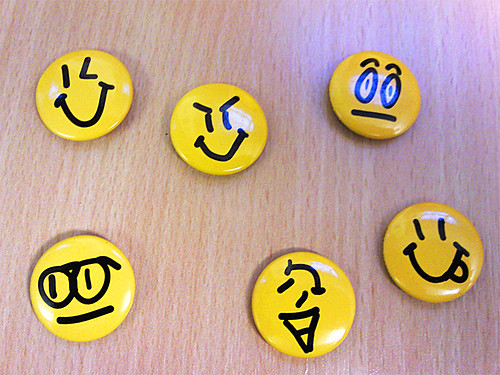
Different people on the Symbian Foundation Launch team have different doodles on their cards. I'm one of the people who ended up with the cartoon that looks to me like a friendly spaceman.

This is probably going to generate some fun talk when I give these out at meetings in Barcelona next week :-)

If you think you could draw a better doodle, then see this invitation.

Footnote: Blogger tells me this is my 100th blog posting. When I wrote the first, back in June last year, I scarcely imagined that my 100th posting would be featuring a friendly spaceman. But as we say in this business, you have to expect the unexpected!

New blog - things are developing nicely

Starting today, there's an official Symbian Foundation blog, here.

The blog will give a flavour of the new Symbian Foundation brand. The declared intention of the blog is "to start a proper dialog with the planet, to introduce ourselves, and to let you know what we're up to".

The site also contains the latest press release of endorsements from companies supporting the Symbian Foundation. With this release, the count of these companies has reached 78.

Monday, February 9, 2009

Preparing for Barcelona

What's the issue that deserves the fullest attention of the best minds of the mobile industry representatives who will be gathering next week at the Mobile World Congress event in Barcelona?

That was one of the questions that I got asked in a quick-fire practice session last week, by a journalist who was employed for the morning to take part in a "media training session" for people from the Symbian Foundation launch team. The idea of the session was to bombard participants with potentially awkward questions, so we could test out various ways to respond. The questions ranged from tame to taxing, from straightforward to subtle, and from respectful to riotous.

One possible answer to the question at the top of this posting is that it is the issue of user experience which deserves the fullest attention. If users continue to be confronted by inflexible technology with unfriendly interfaces, they won't get drawn in to make fullest use of mobile devices and services.

Another possible answer is that it is the issue of complexity which deserves the fullest attention. In this line of thinking, overly complex UIs are just one facet of the problem of overly complex mobile technology. Other facets include:
  • Overly difficult development cycles (resulting in products coming late to the market, and/or products released with too many defects), and
  • Overly exercised CPU cores and overly bloated software (resulting in products with poor battery life and high cost).
However, on reflection, I offer instead the following answer: it is the issue of collaboration which deserves the fullest attention. We need to find better ways for all the good resources of the mobile industry to be productively aligned addressing the same key risks and opportunities, rather than our good intentions ending up pulling in different directions. The problems that we collectively face (including the problems of poor user experience and overly complex software) are surely capable of resolution, if only we can find the way to work together on solutions, rather than our different approaches ending up contradiciting each other and confusing matters.

Open source, whereby people can look at source code and propose changes without having to gain special permission in advance, is part of the solution to improving collaboration. Open discussion and open governance take the solution further. Yet another step comes from collaboration tools that provide first-rate source configuration management and issue tracking.

But collaboration often needs clear leadership to make it a reality: a sufficiently compelling starting point on which further collaboration can take place. Without such a starting point, none of the other items I mentioned can hope to make a lasting difference.

That brings me back to the role of the Symbian Foundation. The Symbian Foundation is offering the entire mobile industry what it claims to be the best possible starting point for further collaboration:
  • A tried and tested codebase of 40 million lines of code;
  • Processes and disciplines that cope with pressures from multiple divergent stakeholders;
  • A visionary roadmap that is informed by the thinking of existing mobile leaders, and which spells out the likely evolution of key mobile technologies.
The Symbian Foundation will be holding a welcome party on Monday evening at Barcelona (8pm-11pm, 16th February). I've been allocated a small number of tickets to this party, to pass to selected bloggers, analysts, and other deep thinkers of the mobile industry. If you'd like to join this party to discuss the points I've made in this posting (or any of the other issues relevant to the formation of the Symbian Foundation), I set you this challenge. Please drop me an email, and provide a link to some of your online writings on applicable topics. (By the way, you don't need to agree with my viewpoint. You just need to demonstrate that you're going to enter into an open-minded, friendly, and constructive debate!)

Sunday, February 8, 2009

Smaller is not necessarily more beautiful

I've been using a Nokia E61i as my main phone for at least 15 months. I'd grown very fond of it.

However, as part of the integration of Symbian's corporate IS structures into those of Nokia, all Symbian employees who previously ran the BlackBerry Connect push email service on older phones like the E61i have been migrated onto a newer phone - the Nokia E71 - with a "Mail for Exchange" connection to the Nokia email servers.

To avoid too many changes happening at exactly the same time, I left it until Thursday this week to unbox my E71 and start personalising it. For about 24 hours, I switched back and forth between the two phones, but I now think the E61i is switched off for good.

First impressions are that, going from the E61i to the E71, there are scores of small but valuable improvements in the usability and feature set of applications. These improvements add up to a powerful reason not to go back to the E61i. They've been very nicely implemented.

Another big plus point is the built-in GPS.

No wonder the E71 has received so many rave reviews.

But yet, but yet, but yet: I confess to missing the larger keyboard and the larger screen of the older phone. For someone who does a great deal of data entry into my smartphone, the smaller keys (although implemented as a technological marvel) mean that I mis-hit keys more often than before. (And several keys have been removed from the keyboard altogether - you now need to use the "Chr" key to type them in.)

Another slight drawback of the smaller form factor is that, to my mind, the vibrator is less powerful, and more easily missed. So I've missed more incoming phone calls in the last few days than in the preceding week. (I'll need to develop some greater sensitivity...)

Whilst the prevailing wisdom in the smartphone industry is that smaller and lighter phones reach larger markets, I count myself as part of a small but growing sub-market of users that would prefer larger hardware. For us, a larger keyboard and screen - up to a point - add significantly to the overall usability of the device as a high-volume data-input and data-output terminal.

The iPhone is another example of a phone that was larger than prevailing wisdom said would be tolerated by mainstream purchasers. Previous to the launch of the iPhone, industry usability experts held the opinion that a device with the dimensions of the iPhone would inevitably have a limited market. However, as the iPhone shows, if the user experience is good enough, worries about device size tend to fall away.

So I am personally looking forward to seeing the software enhancements of the E71 available in larger devices - whether these devices are called "smartphones" or "MIDs" or whatever.

Small is beautiful - yes - but it's not the only beauty.

Footnote: For an excellent introduction to the E71 from the point of view of an E61i user, see the comprehensive comparative review by Steve Litchfield.

Friday, February 6, 2009

Reviewing architecture

I spent two days earlier this week in the company of a group of highly experienced software architects. As you may be aware, software architects are a special breed of people. They're the people who enjoy worrying about the fundamental technical design of a software system. They try to identify, in advance:
  • The best partitioning of the overall system into inter-connected parts ("divide and conquer");
  • The approach to the design that will preserve the right amount of flexibility for future evolution of the system ("design for change: expect the unexpected");
  • The technical decisions that will have the biggest impact on the lifetime success of the system ("finding the biggest bang per buck");
  • The aspects of the design that will become the hardest to change (and which, therefore, are the most urgent to get right);
  • The software development processes that will be the most sacrosanct in the creation of the system (the processes that even the best software engineers will be obliged to follow).
People who get these decisions right are among the most valuable members of the entire project team.

The software architects that I met over these two days were employees from eight of the initial board member companies of the Symbian Foundation. This group of architects has been meeting roughly once a month, for around the last six months, to carry out preparatory work ahead of the formal launch of the Symbian Foundation. The grouping goes by the name "Architecture and software collaboration working group". Because that's a bit of a mouthful, it's usually abbreviated to ASW WG.

It's not the only such working group. For example, there's also the FRR WG (looking at Feature, Roadmap and Releases), the FOL WG (Foundation Operational Launch), the FG WG (Foundation Governance), and the IMC WG (Interim Marketing & Communications). In each case, the working group consists of personnel from the initial board member companies, who meet regularly (face-to-face or on a conference call) to progress and review projects.

Several of these working groups will transition into ongoing "councils" when the Symbian Foundation is launched. For example, the ASW WG will transition into the Architecture Council. The Symbian Foundation councils are being formed with the purpose to support the foundation community and grow the competitiveness of the Symbian platform by:
  • Identifying high-level market, user and technical requirements;
  • Soliciting contributions that address those requirements;
  • Coordinating community contributions into regular platform releases;
  • Providing transparency for all community members regarding future platform developments.

The four main councils can be summarised as follows:

  • The Feature and Roadmap Council invites proposals for contributions from the community and seeks to coordinate new contributions into a unified platform (or tools) roadmap;
  • The Architecture Council invites and reviews technical solutions for new contributions in order to ensure the architectural integrity, backward compatibility and fitness-for-purpose of enhancements to the platform;
  • The User Interface Council invites and reviews descriptions of new user interface elements and develops guidelines to help ensure high quality device user experiences;
  • The Release Council coordinates the integration of contributions into stable and timely platform and tools releases.
As I said, I attended this week's meeting of the ASW WG. Personnel from eight of the initial board member companies were present. It was evident that some of the architects were already on very familiar terms with each other - they've worked together on previous Symbian projects over the years. Other participants spoke less often, and seemed to be newer to the group - but when they did speak up, their contribution was equally pertinent.

The meeting had a full agenda. About half of the time was devoted to collectively reviewing (and in some cases reworking) documents that are to be published on the Symbian Foundation web infrastructure around the time of the launch of the organisation. These documents included:
  • The operating charter for the Architecture Council
  • Foundation device software structuring principles
  • Template and Example for Technical Solution Descriptions
  • Foundation Device Compatibility Verification Process
  • Reference Execution Environment Selection Process
  • Recommended practice in the use of the software collaboration tools chosen by the Symbian Foundation - including the SCM (Mercurial) and Issue Tracking (Bugzilla) tools.

The rest of the meeting involved:

  • A discussion of the XML metadata files which are to be maintained (by package owners) for each component in the whole system
  • A review of progress of the project to create the infrastructure and web services which will be accessed by foundation members and by the general public following the launch of the foundation
  • A discussion of the principles for identifying and supporting package owners.

From time to time, the gathering briefly bordered on the surreal. For example, it was debated whether packages should most accurately be described as "collections of collections of packages" instead of "collections of packages". And there was a serious discussion of whether "vendor supported environment" should gain a hyphen, to become "vendor-supported environment". But this kind of intense scrutiny is what you'd expect from the highly analytic individuals in attendance - especially when you realise that it's the desire of these architects to communicate their design ideas as clearly and unambiguously as possible.

(I say all this from the standpoint of someone who had "Software Architect" as the job title on my business cards for several years in the early 1990s.)

Indeed, there was a lot of good-natured ribbing between the attendees. The remark "You might hate me for suggesting this, but..." was interrupted by the rejoinder, "Don't worry, I already hate you", followed by laughter.

The meeting became particularly animated, near the end, during the review of the project to create the Symbian Foundation web infrastructure. It became clear to the working group members that the documents they had long debated and refined would soon become published to a much, much wider audience. All the months of careful preparation will culminate in what is anticipated to be a flurry of interest from Symbian Foundation members in the proposals and votes that will take place at the first meetings of the councils:

  • Although there will be at most 12 voting members on any of these councils, the agendas and supporting documents will be made visible to all Symbian Foundation members in advance of council meetings;
  • These members will be able to make their own opinions known through channels such as mailing lists;
  • Over time, the members who repeatedly raise the most insightful comments and suggestions about the business of a council will be invited to formally join that council (and will gain voting rights).

Monday, February 2, 2009

A question for Blogger experts

A question for the hive mind:

When I created this blog, I created a Google Account at the same time, with the blog associated with it. The Google Account is defined with my old email address. How do I get it moved to a new email address?

The main reason I want it changed is because I want the notification emails (sent by Blogger whenever anyone posts a comment here) to come direct to my new address, rather than my old one.

At first sight, this seems simple: the "My Account" link on the Blogger home page opens a page which in turn has a "Change email" link on it. Alas, if I type in my intended new email address, an error message is shown:
  • A user with the email you specified already exists
In a way, this is no surprise, since that new address is being provided by Google Apps. So I've already got two different Google Accounts - one attached to this blog, and the other attached to my new email address. Ideally, I'd like to merge these two accounts, but I doubt this is possible...?

That takes me to plan B: keep the blog associated with the same account as before, but alter this account so that notification emails are sent to a different email address. But at the moment, I don't seem to be able to do that either.

Does anyone have any bright ideas?

Sunday, February 1, 2009

Signs of change

My main place of work since September 2000 has been Symbian's offices at #2 Boundary Row, a short walk from Southwark tube station in central London. During all that time, the building has displayed signs with the "Symbian" name.

But when I visited the site earlier today, the signs of Nokia's acquisition of Symbian are now very visible: the Symbian signage has been replaced by Nokia signage.

1st February marks the next stage in the integration of Symbian, the company, into Nokia. As with all large changes, the idea is to tackle things stage by stage - to avoid too many things all changing at the same time. Legally, Symbian became a part of Nokia Group back in December. 1st February sees Symbian employees adopting new email addresses, new security passes, and logging into a new network. More changes will occur in the weeks and months ahead - including key dates in the launch of the Symbian Foundation organisation, and the availability of Symbian Platform releases (replacing the previously separate Symbian OS and UI releases).

Joining Nokia's IS network also means retiring Lotus Notes as our mail engine (although we'll keep using Lotus Notes for various internal discussion databases and other groupware purposes). Those of us who are working as part of the launch team for the Symbian Foundation are experimenting with Google Apps as the provider of our email services. I've had a Google Mail account for my personal use for a number of years, so I'm already familiar with this system. It's got some fine features. My first couple of days using it for business purposes, however, are making me wonder if it really is fit for more demanding usage. Time will tell. In the meantime, to my mind it's another illustration that browser-based apps are not yet fit to fully displace locally hosted apps. They're not fit to fully displace such apps on the PC, and they're very definitely not fit to fully displace such apps on mobile devices.

Friday, January 30, 2009

Century reached in Japan

Last Monday (26th January), leading Japanese network operator NTT DoCoMo starting selling the F-06A mobile phone. The phone is manufactured by Fujitsu and is based on Symbian OS v9.4.

The F-06A has some notable features, that have been designed with one special type of customer in mind: businesses that worry about the possibility of misuse of phones in the possession of their employees. To reduce the likelihood of information leakage or unsanctioned use of the handset outside approved corporate purposes, businesses can:
  • Manage these phones remotely, including initialisation and re-configuration;
  • Remotely reset the data on the handset (including contacts, schedule, messages, call log, and media gallery);
  • Remotely lock down or limit usage of functions such as camera or infrared connectivity.
At the same time, the phone lacks a memory card slot, and omits support for mass storage PC connectivity mode. Other features that are common on advanced phones in Japan, such as mobile wallet payment, digital TV, and entertainment services, are also omitted or deprioritised. These omissions may lower the attractiveness of the phone in the eyes of some users, but boost the attractiveness of the phone in the eyes of the company purchasing them.

This can be seen as another example of the "less is more" principle: for some markets, you create a better product by removing features, rather than by adding more. The resulting simplicity of operation can have its own attraction. Fujitsu have already benefited richly from applying this same principle in their renowned "Raku Raku" series of easy-to-use phones for the NTT DoCoMo network - initially launched in September 2004, and a runaway success since that time.

To be clear, neither the F-06A nor the Raku Raku phones are technology weaklings. They contain their own extensive mix of advanced hardware, software, and network connectivity. For example, the F-06a has internal and external (3.2 megapixel) cameras, a rotatable 3.2-inch wide VGA TFT screen with 16 million colours, Flash Lite 3, GPS, fingerprint identification, and so on and so on. But the choice of what's included and what's excluded gives this phone its own unique flavour.

The F-06A is significant in the Symbian story in one more way: it's the 100th Symbian-powered phone model to come to the market in Japan. The very first such phone - the FOMA F2051 - went on sale in January 2003, almost six years to the day before the launch of the F-06A. The creators of that first breakthrough phone were also Fujitsu. The internal codename for the F2051 project was "Sakura", which is Japanese for cherry blossom.

About six months before the launch of Sakura, things were looking far less rosy for Symbian in Japan. Any prospect that, before the end of the decade, 100 different Symbian phone models would come to market in Japan, would have seemed far-fetched:
  • The underlying theory was strong: a reusable and customisable smartphone platform (Symbian OS) would support a wide range of differentiated products;
  • The initial engagement was also strong: no less than five Japanese phone manufacturers had commenced projects to create Symbian phones (and several more were considering doing the same);
  • But the reality of smartphone project development turned out very disappointing in these early years. Many of the initial projects foundered, became delayed, and were eventually cancelled;
  • There was a depressing period in which it seemed that, every few weeks, another project terminated unsuccessfully: the task of bringing complex new 3G handsets to market was much more difficult than anticipated.

Thankfully, the engineering team in Fujitsu proved highly capable and resilient. Backed by a slowly growing team of expert technical consultants based in the Symbian KK offices in downtown Tokyo, and by an ever-more mature network of Symbian Competence Centres such as K3 (Kanrikogaku Kenkyusho), Fujitsu commenced a long series of successful Symbian phone introductions. In time, they were joined by a range of other Japanese phone manufacturers: Mitsubishi, Sony Ericsson, and Sharp.

To date, the 100 Japanese phone models have, between them, sold more than 40 million phones - with an average sales volume, evidently, of somewhat over 400,000 units. It's an astonishing accomplishment. I'd like to take this opportunity to publicly express my hearfelt gratitude and admiration to all the staff in Symbian KK and in Symbian's Japanese cutomers and partners, past and present, who have laboured long and intelligently in support of this century of successful smartphone development projects. Happily, there's been widespread application of the fine Japanese virtues of step-by-step incremental improvement, and constant learning and innovation. This converted Symbian's Japanese offering from a set of PowerPoint marketing pictures and bullets into a reality of hard-won bone-deep knowledge of the intricacies and complications of smartphone integration. The result, from Sakura onwards, has been a dazzling blossoming of both technology and customer experience.

Wednesday, January 28, 2009

Package Owners contemplating the world ahead

I've just spent two days at the very first Symbian Foundation "Package Owners workshop", held in a Nokia training facility at Batvik, in the snow-covered countryside outside Helsinki. The workshop proved both thought-provoking and deeply encouraging.

In case the term "package owner" draws a blank with you, let me digress.

Over the last few years, there have been several important structural rearrangements of the Symbian OS software engineering units, to improve the delivery and the modularity of the operating system code. For example, we've tracked down and sought to eliminate instances where any one area of software relied on internal APIs from what ought to have been a separate area.

This kind of refactoring is an essential process for any large-scale fast-evolving software system - otherwise the code will become unmaintainable.

This modularisation process is being taken one stage further during the preparation for opening the sources of the entire Symbian Platform (consisting of Symbian OS plus UI code and associated applications and tools). The platform has been carefully analysed and divided up into a total of around 100 packages - where each package is a sizeable standalone software delivery. Each package will have its own source code repository.

(Packages are only one layer of the overall decomposition. Each package is made up of from 1 to n component collections, which are in turn made up of from 1 to n components. In total, there are around 2000 components in the platform. Going in the other direction, the packages are themselves grouped into 14 different technology domains, each with a dedicated "Technology Manager" employed by the Symbian Foundation to oversee their evolution. But these are stories for another day.)

Something important that's happened in the last fortnight is that package owners have been identified for each of the packages. These package owners are all highly respected software engineers within their domain of expertise.

We're still working on the fine detail of the description of the responsibilities of package owners, but here's a broad summary:
  • Publish the roadmap for their package
  • Have technical ownership for the package
  • Be open to contributions to their package from the wider software community
  • Evalutate all contributions, and provide useful feedback to the contributors
  • Maintain a good architecture for the package
  • Act as feature sponsor in their package area
  • Manage package deliveries.
This is a huge task, so most package owners will rely on a network of approved committers and other supporters in order to carry out their role.

(Instead of "package owner", the word "maintainer" is used with a similar meaning by some other open source projects.)

Over the next month, the nominated package owners (along with some of their line managers) are each attending one of three introductory workshops. Each workshop lasts two days. The goal of the workshop is to review and discuss how software development processes will alter, once the source code for the package is available to a much wider audience. Many processes will remain the same as before, but others will alter, and yet others will be brand new.

As I said, the first of these workshops has just finished. There were people from at least three different continents in attendance. I knew a handful before, but for many others, it was the first time for me to meet them. Without exception, they are singularly impressive individuals, with great CVs, and (in most cases) with glittering track records inside Nokia or Symbian.

Not surprisingly, the newly minted package owners brought a variety of different expectations to the event. Several already have considerable experience working with open source software. Others are, naturally, somewhat apprehensive about the changes.

A series of presenters covered matters such as:
  • An overview of the operation and architecture of the Symbian Foundation
  • Great software developers and open source principles
  • Tips on growing a successful community of external contributors
  • The importance of meritocracy
  • Tools and processes
  • IPR considerations, licensing issues, and legal aspects.

There were also small group breakout sessions on topics such as "What are the key challenges and issues facing package owners?" and "What are we going to do differently from before?"

What impressed me the most were the events on the first evening. After a dinner and optional sauna session, the participants gathered again in the seminar room, and spent another three hours reviewing ideas arising from the group breakout sessions from earlier in the day. The passion of the package owners stood out. In their own individual ways, they displayed a shared strong desire to explore new ways of engaging a wider community of software developers, without destabilising the mission-critical projects already being undertaken. These are all busy people, with multiple existing tasks, but they were ready to brainstorm ways to adopt new skills and processes in order to improve the development of their packages. (And I don't think it was just the Lapin Kulta speaking.)

I half expected the fervour of the debate to die down after a while, but the buzz in the room seemed as strong at 10.50pm as at 8pm. There was a constant queue of people trying to get hold of the marker pen which had been designated (with limited success) as giving someone the right to speak to group. The workshop facilitator had to speak up forcefully to point out that the facilities would be locked shut in ten minutes.

With this kind of intelligence and fervour being brought to bear in support of the Symbian Foundation's tasks, I'm looking forward to an exciting time ahead.

Wednesday, January 21, 2009

2009 - end users modifying their mobile phone apps

Here's a scenario I expect to become increasingly common later this year.

(Elements in the following story are made up, of course, but they serve as placeholders for anticipated real people, real phones, and real apps.)

Vijaya is really fond of her new Nokia N225 based on the latest Symbian Platform Release, and is both intrigued and frustrated by features of the Jomo Player app that's built into that phone. The app does some very clever things, but yet, Vijaya thinks it would serve her own needs better if some of the behaviour and functionality were changed. She also has ideas for tweaking the UI.

If this story were set in 2008, that would probably be the end of the story. Vijaya might write about her ideas on Facebook, and her friend Sunil might send them to someone he knows who has a job in the Nokia Devices R&D lab, but the chances are, the original developers of the Jomo Player app would be far too busy to pay attention to what appear to be idiosyncratic, quaint, or overly personalised change suggestions.

Now let's make this story more interesting. Suppose that Vijaya already knows some Symbian C++. Maybe she took a course on it at the local technical university, which is enrolled into the Symbian Academy program. Or maybe she used to work for a phone manufacturer helping to customise their Symbian devices. So, either way, Vijaya starts writing an alternative Jomo Player app, starting from scratch. Her goal is to embody her own ideas on usability and feature set.

But guess what: her alternative Jomo Player falls far short of the performance and power of the built-in app. It's tough to re-create a complex app. Although Symbian in 2008 is an open platform, with rich APIs, it's not at all obvious to Vijaya how to emulate, in her version of the app, many of the features of the original, which she now comes to increasingly recognise as subtle and refined. Some of Vijaya's friends band together to help, but they eventually abandon the project. The original app, they realise, is doing some incredibly complex things under the surface - and their attempted clone comes nowhere close to matching it. So, in 2008, that really is the end of the story.

Now let's re-run this story sometime later on in 2009. The source code for the original Jomo Player app is available for download from the Symbian Foundation Mercurial code repository, under the open source Eclipse Public Licence. What's more, the publicly available SDKs provide enough header files and libraries that Vijaya and her friends can rebuild the entire app. So the starting point is very different. Rather than struggling to create the whole app from scratch, Vijaya can fairly easily locate the parts of the source code she wants to change. As a result, she has a new version of the Jomo Player on her N225 in less than a week. As a result of using this app some more, with its altered features, she and her friends get yet more ideas - and then a major breakthrough flash. The new app quickly evolves into a dramatically better state.

Shortly afterwards, Vijaya makes her new app available via several application stores. It gets rave reviews. These reviews come to the attention of product managers in one or more phone companies. Both the N226 and a new Samsung phone build this version of the app into their ROMs, and reach millions of happy smartphone customers well before Christmas.

Vijaya started this whole process by scratching a personal itch. She wanted to improve a particular app running on her own phone. However, unexpectedly, she now has three different Symbian development houses competing to hire her into their teams.

In parallel, Mika has altered the Voton Reader app so that it's more usable by his mother. (It turns out, afterwards, to be more usable by almost everyone!) Antony has added a whole series of shortcut keys to the Contacts app. And Alexa has produced a stunning new combination of two originally separate apps.

That's the difference between what can be accomplished by an open platform (with published APIs) and by an open source platform (with published, buildable source code).

As 2009 progresses, the mobile phone platforms that publish their source code will increasingly play host to deeper and more interesting forms of innovation, than those mobile platforms which keep their source code closed. The phones from these open source mobile platforms (such as Symbian) will have the best Mojo Player, Voton Readers, and so on - not because the developers inside Symbian are cleverer than those in other mobile phone platform companies, but because these platforms can take greater advantage of the much wider pool of creative and clever people who are outside the company.

Footnote: Credit for key elements of this vision belong to some of my colleagues on the Symbian Foundation launch team, including William Roberts and Antony Edwards.

Disclaimer: The devil's in the detail. Thoughtful readers will realise there are lots of important details missing from the above story. I look forward to returning to these details.