Saturday, February 28, 2009

Ambushed

The invitation made good sense to me:

Apologies for the short notice but are you free tomorrow afternoon [Friday] after 3pm to meet with us to provide your feedback on MWC please? It should only take 30 mins or so.
It would be a chance to discuss with the Symbian Foundation marcomms team my reflections on our activities at the Mobile World Congress event in Barcelona the previous week: what had gone well, where there was room to improve, what we should try to do differently at future events, and so on. As a big fan of the practice of retrospection, I was happy to carve out 30 minutes in my diary for this purpose.

As I climbed up the stairs to the first floor of #1 Boundary Row - where the marcomms team sits - I briefly rehearsed my thoughts. I had many positive recollections of how everyone had prepared for and then supported the Symbian Foundation presence at Barcelona. (My main negative observation was that the music in the party was, at times, a bit too loud, and impeded networking conversations.)

But when I came into the room, Anatolie Papas asked me to review a press release. I could see there were lots of quotes on it. Then I noticed the title of the release:

DW 2.0 TURNS 5.0

SLIGHTLY BELATED BIRTHDAY PRESS RELEASE FOR IMMEDIATE DISTRIBUTION!

The man who helped put the ‘smart’ in ‘smartphone’ celebrates his half century and becomes a friendly spaceman
and I realised I was being ambushed - but in a very pleasant way!

Then a cake materialised, magnificently decorated with what is becoming an increasingly familiar picture:


A knife and forks appeared, and we collectively set to dividing up the cake and eating it. It was particuarly yummy! (The marcomms team get the credit for the design of the cake, but the manufacture was apparently by Konditor and Cook.)

The endorsements on the "press release" left me (unusually) lost for words. I won't repeat the endorsements here - that would be far too indulgent - but I do nominate Bruce Carney (from Symbian's Foster City office) as the provider of the geekiest quote:

“Congratulations on your 0x32nd birthday and thank you for your tireless contribution to get Symbian to where it is today; ready for the most exciting decade in all of our lives; the 'Internet without wires'”, said Bruce Carney, Symbian^h^h^h^h^h^h^h Nokia.

The upbeat creativity that shone through this "press release" gives me all the more reason to be confident that this team will continue to devise and deliver suberb market communications as the rest of the Symbian Foundation accelerates into top gear over the months ahead.

Tuesday, February 17, 2009

Symbian Foundation membership documents now available

Anyone interested in the process for becoming a member of the Symbian Foundation can now download and view the relevant set of documents here.

These documents comprise:
  • An electronic membership application form;
  • A copy of the Symbian Foundation Licence (applicable to the source code in the Symbian Foundation Platform until such time as that code becomes available under the Open Source Eclipse Public Licence);
  • The Symbian Foundation membership rules;
  • The Symbian Foundation trademark and compliance policy;
  • The Symbian Foundation patent policy;
  • The memorandum of association of Symbian Foundation Limited;
  • The deed of adherence which an organisation must sign to become a member;
  • The member contribution agreement (applicable to those organisations that may wish to contribute code to the Symbian Foundation Platform).
Many congratulations to the team who have worked so hard to prepare these documents for publication!

There's a lot of information in these documents. If anyone has questions, the first place to look is the online FAQ.

Sunday, February 15, 2009

Deja vu, with a difference

As I walked through Barcelona airport this morning, my mind was jostled by sights and sounds remembered from my previous visits here. I'm in town to attend the annual Mobile World Congress trade show. (The show used to be called "3GSM", and before that, "GSM World".)

I've been attending this show every year since 2002. From 2002-05 it was held at Cannes, in France, in increasingly cramped circumstances - as the mobile industry grew and grew and grew. Since 2006 it has taken place 300 miles south west along the Mediterranean coast in Barcelona. So today marks my fourth annual visit to Barcelona airport.

As I walked through the airport, I found myself remembering:
  • that was the place where on my first visit, I had walked out of the wrong exit, and needed to go back in through a lengthy security screening process again before I could pick up my luggage;
  • that was the place where, another year, I had queued up to report that my luggage was missing (happily, it was delivered to my hotel by first thing the following morning);
  • that was the coffee shop where I had relaxed with some colleagues before going to the gate on the way home one year;
  • that was the restaurant where I had eaten a meal with a slightly different set of colleagues a different year, while awaiting news of delayed departure times; and so on.
The place is full of memories. But there's a big difference this year. The remembrances of similarity mask underlying transitions.

For example, I'll be spending a lot of my time over the next few days at the same hospitality suite as in previous years - AV91 on the main Fira avenue - but the suite has a very different feel this year. Here's a picture of the outside of the suite, taken earlier today:


As you can see, the suite was still under construction - but some elements of the emerging Symbian Foundation branding are visible. The "friendly spaceman" has a side panel all to himself:


Other Symbian Foundation doodle characters are also visible: the inspired toaster, and so on. (No, these names aren't official...)

Again, I'll also be spending time at the same stand location as before - 8A77, in Hall 8 - but, again, the feel has changed:


What's more, many of the colleagues who came with me to previous Mobile World Congress events, aren't attending this year. The other members of the Symbian Leadership Team are primarily engaged these days in important internal integration projects inside Nokia, and have no reason to travel to Barcelona this year. So I'll be sharing my duties - meeting press, analysts, bloggers, partners, and potential new members of the Symbian Foundation community - with a new set of Leadership Team colleagues - the members of the emerging Symbian Foundation Leadership Team.

Finally, the emphasis of these meetings will be less on the number of phones shipped, and more on the growing vibrancy and productivity of the Symbian Foundation community. After all, we can only aspire to provide the most widely used software on the planet if, along the way, we grow the most productive and valuable software movement on the planet.

Footnote: Another visible difference, from last year, is that the number of large advertising hoardings scattered all over the city seems significantly less this year.

Thursday, February 12, 2009

I'm a friendly spaceman

A box of my new business cards arrived today - one day ahead of schedule.

They have some elements of the new Symbian Foundation branding:


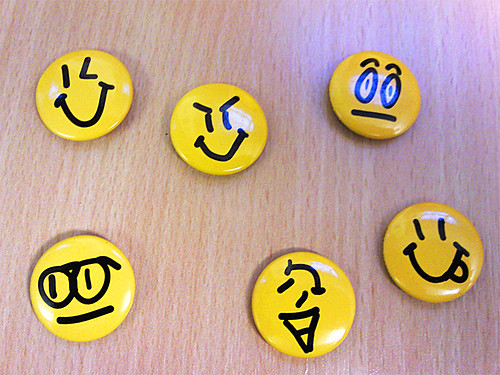
Different people on the Symbian Foundation Launch team have different doodles on their cards. I'm one of the people who ended up with the cartoon that looks to me like a friendly spaceman.

This is probably going to generate some fun talk when I give these out at meetings in Barcelona next week :-)

If you think you could draw a better doodle, then see this invitation.

Footnote: Blogger tells me this is my 100th blog posting. When I wrote the first, back in June last year, I scarcely imagined that my 100th posting would be featuring a friendly spaceman. But as we say in this business, you have to expect the unexpected!

New blog - things are developing nicely

Starting today, there's an official Symbian Foundation blog, here.

The blog will give a flavour of the new Symbian Foundation brand. The declared intention of the blog is "to start a proper dialog with the planet, to introduce ourselves, and to let you know what we're up to".

The site also contains the latest press release of endorsements from companies supporting the Symbian Foundation. With this release, the count of these companies has reached 78.

Monday, February 9, 2009

Preparing for Barcelona

What's the issue that deserves the fullest attention of the best minds of the mobile industry representatives who will be gathering next week at the Mobile World Congress event in Barcelona?

That was one of the questions that I got asked in a quick-fire practice session last week, by a journalist who was employed for the morning to take part in a "media training session" for people from the Symbian Foundation launch team. The idea of the session was to bombard participants with potentially awkward questions, so we could test out various ways to respond. The questions ranged from tame to taxing, from straightforward to subtle, and from respectful to riotous.

One possible answer to the question at the top of this posting is that it is the issue of user experience which deserves the fullest attention. If users continue to be confronted by inflexible technology with unfriendly interfaces, they won't get drawn in to make fullest use of mobile devices and services.

Another possible answer is that it is the issue of complexity which deserves the fullest attention. In this line of thinking, overly complex UIs are just one facet of the problem of overly complex mobile technology. Other facets include:
  • Overly difficult development cycles (resulting in products coming late to the market, and/or products released with too many defects), and
  • Overly exercised CPU cores and overly bloated software (resulting in products with poor battery life and high cost).
However, on reflection, I offer instead the following answer: it is the issue of collaboration which deserves the fullest attention. We need to find better ways for all the good resources of the mobile industry to be productively aligned addressing the same key risks and opportunities, rather than our good intentions ending up pulling in different directions. The problems that we collectively face (including the problems of poor user experience and overly complex software) are surely capable of resolution, if only we can find the way to work together on solutions, rather than our different approaches ending up contradiciting each other and confusing matters.

Open source, whereby people can look at source code and propose changes without having to gain special permission in advance, is part of the solution to improving collaboration. Open discussion and open governance take the solution further. Yet another step comes from collaboration tools that provide first-rate source configuration management and issue tracking.

But collaboration often needs clear leadership to make it a reality: a sufficiently compelling starting point on which further collaboration can take place. Without such a starting point, none of the other items I mentioned can hope to make a lasting difference.

That brings me back to the role of the Symbian Foundation. The Symbian Foundation is offering the entire mobile industry what it claims to be the best possible starting point for further collaboration:
  • A tried and tested codebase of 40 million lines of code;
  • Processes and disciplines that cope with pressures from multiple divergent stakeholders;
  • A visionary roadmap that is informed by the thinking of existing mobile leaders, and which spells out the likely evolution of key mobile technologies.
The Symbian Foundation will be holding a welcome party on Monday evening at Barcelona (8pm-11pm, 16th February). I've been allocated a small number of tickets to this party, to pass to selected bloggers, analysts, and other deep thinkers of the mobile industry. If you'd like to join this party to discuss the points I've made in this posting (or any of the other issues relevant to the formation of the Symbian Foundation), I set you this challenge. Please drop me an email, and provide a link to some of your online writings on applicable topics. (By the way, you don't need to agree with my viewpoint. You just need to demonstrate that you're going to enter into an open-minded, friendly, and constructive debate!)

Sunday, February 8, 2009

Smaller is not necessarily more beautiful

I've been using a Nokia E61i as my main phone for at least 15 months. I'd grown very fond of it.

However, as part of the integration of Symbian's corporate IS structures into those of Nokia, all Symbian employees who previously ran the BlackBerry Connect push email service on older phones like the E61i have been migrated onto a newer phone - the Nokia E71 - with a "Mail for Exchange" connection to the Nokia email servers.

To avoid too many changes happening at exactly the same time, I left it until Thursday this week to unbox my E71 and start personalising it. For about 24 hours, I switched back and forth between the two phones, but I now think the E61i is switched off for good.

First impressions are that, going from the E61i to the E71, there are scores of small but valuable improvements in the usability and feature set of applications. These improvements add up to a powerful reason not to go back to the E61i. They've been very nicely implemented.

Another big plus point is the built-in GPS.

No wonder the E71 has received so many rave reviews.

But yet, but yet, but yet: I confess to missing the larger keyboard and the larger screen of the older phone. For someone who does a great deal of data entry into my smartphone, the smaller keys (although implemented as a technological marvel) mean that I mis-hit keys more often than before. (And several keys have been removed from the keyboard altogether - you now need to use the "Chr" key to type them in.)

Another slight drawback of the smaller form factor is that, to my mind, the vibrator is less powerful, and more easily missed. So I've missed more incoming phone calls in the last few days than in the preceding week. (I'll need to develop some greater sensitivity...)

Whilst the prevailing wisdom in the smartphone industry is that smaller and lighter phones reach larger markets, I count myself as part of a small but growing sub-market of users that would prefer larger hardware. For us, a larger keyboard and screen - up to a point - add significantly to the overall usability of the device as a high-volume data-input and data-output terminal.

The iPhone is another example of a phone that was larger than prevailing wisdom said would be tolerated by mainstream purchasers. Previous to the launch of the iPhone, industry usability experts held the opinion that a device with the dimensions of the iPhone would inevitably have a limited market. However, as the iPhone shows, if the user experience is good enough, worries about device size tend to fall away.

So I am personally looking forward to seeing the software enhancements of the E71 available in larger devices - whether these devices are called "smartphones" or "MIDs" or whatever.

Small is beautiful - yes - but it's not the only beauty.

Footnote: For an excellent introduction to the E71 from the point of view of an E61i user, see the comprehensive comparative review by Steve Litchfield.

Friday, February 6, 2009

Reviewing architecture

I spent two days earlier this week in the company of a group of highly experienced software architects. As you may be aware, software architects are a special breed of people. They're the people who enjoy worrying about the fundamental technical design of a software system. They try to identify, in advance:
  • The best partitioning of the overall system into inter-connected parts ("divide and conquer");
  • The approach to the design that will preserve the right amount of flexibility for future evolution of the system ("design for change: expect the unexpected");
  • The technical decisions that will have the biggest impact on the lifetime success of the system ("finding the biggest bang per buck");
  • The aspects of the design that will become the hardest to change (and which, therefore, are the most urgent to get right);
  • The software development processes that will be the most sacrosanct in the creation of the system (the processes that even the best software engineers will be obliged to follow).
People who get these decisions right are among the most valuable members of the entire project team.

The software architects that I met over these two days were employees from eight of the initial board member companies of the Symbian Foundation. This group of architects has been meeting roughly once a month, for around the last six months, to carry out preparatory work ahead of the formal launch of the Symbian Foundation. The grouping goes by the name "Architecture and software collaboration working group". Because that's a bit of a mouthful, it's usually abbreviated to ASW WG.

It's not the only such working group. For example, there's also the FRR WG (looking at Feature, Roadmap and Releases), the FOL WG (Foundation Operational Launch), the FG WG (Foundation Governance), and the IMC WG (Interim Marketing & Communications). In each case, the working group consists of personnel from the initial board member companies, who meet regularly (face-to-face or on a conference call) to progress and review projects.

Several of these working groups will transition into ongoing "councils" when the Symbian Foundation is launched. For example, the ASW WG will transition into the Architecture Council. The Symbian Foundation councils are being formed with the purpose to support the foundation community and grow the competitiveness of the Symbian platform by:
  • Identifying high-level market, user and technical requirements;
  • Soliciting contributions that address those requirements;
  • Coordinating community contributions into regular platform releases;
  • Providing transparency for all community members regarding future platform developments.

The four main councils can be summarised as follows:

  • The Feature and Roadmap Council invites proposals for contributions from the community and seeks to coordinate new contributions into a unified platform (or tools) roadmap;
  • The Architecture Council invites and reviews technical solutions for new contributions in order to ensure the architectural integrity, backward compatibility and fitness-for-purpose of enhancements to the platform;
  • The User Interface Council invites and reviews descriptions of new user interface elements and develops guidelines to help ensure high quality device user experiences;
  • The Release Council coordinates the integration of contributions into stable and timely platform and tools releases.
As I said, I attended this week's meeting of the ASW WG. Personnel from eight of the initial board member companies were present. It was evident that some of the architects were already on very familiar terms with each other - they've worked together on previous Symbian projects over the years. Other participants spoke less often, and seemed to be newer to the group - but when they did speak up, their contribution was equally pertinent.

The meeting had a full agenda. About half of the time was devoted to collectively reviewing (and in some cases reworking) documents that are to be published on the Symbian Foundation web infrastructure around the time of the launch of the organisation. These documents included:
  • The operating charter for the Architecture Council
  • Foundation device software structuring principles
  • Template and Example for Technical Solution Descriptions
  • Foundation Device Compatibility Verification Process
  • Reference Execution Environment Selection Process
  • Recommended practice in the use of the software collaboration tools chosen by the Symbian Foundation - including the SCM (Mercurial) and Issue Tracking (Bugzilla) tools.

The rest of the meeting involved:

  • A discussion of the XML metadata files which are to be maintained (by package owners) for each component in the whole system
  • A review of progress of the project to create the infrastructure and web services which will be accessed by foundation members and by the general public following the launch of the foundation
  • A discussion of the principles for identifying and supporting package owners.

From time to time, the gathering briefly bordered on the surreal. For example, it was debated whether packages should most accurately be described as "collections of collections of packages" instead of "collections of packages". And there was a serious discussion of whether "vendor supported environment" should gain a hyphen, to become "vendor-supported environment". But this kind of intense scrutiny is what you'd expect from the highly analytic individuals in attendance - especially when you realise that it's the desire of these architects to communicate their design ideas as clearly and unambiguously as possible.

(I say all this from the standpoint of someone who had "Software Architect" as the job title on my business cards for several years in the early 1990s.)

Indeed, there was a lot of good-natured ribbing between the attendees. The remark "You might hate me for suggesting this, but..." was interrupted by the rejoinder, "Don't worry, I already hate you", followed by laughter.

The meeting became particularly animated, near the end, during the review of the project to create the Symbian Foundation web infrastructure. It became clear to the working group members that the documents they had long debated and refined would soon become published to a much, much wider audience. All the months of careful preparation will culminate in what is anticipated to be a flurry of interest from Symbian Foundation members in the proposals and votes that will take place at the first meetings of the councils:

  • Although there will be at most 12 voting members on any of these councils, the agendas and supporting documents will be made visible to all Symbian Foundation members in advance of council meetings;
  • These members will be able to make their own opinions known through channels such as mailing lists;
  • Over time, the members who repeatedly raise the most insightful comments and suggestions about the business of a council will be invited to formally join that council (and will gain voting rights).

Monday, February 2, 2009

A question for Blogger experts

A question for the hive mind:

When I created this blog, I created a Google Account at the same time, with the blog associated with it. The Google Account is defined with my old email address. How do I get it moved to a new email address?

The main reason I want it changed is because I want the notification emails (sent by Blogger whenever anyone posts a comment here) to come direct to my new address, rather than my old one.

At first sight, this seems simple: the "My Account" link on the Blogger home page opens a page which in turn has a "Change email" link on it. Alas, if I type in my intended new email address, an error message is shown:
  • A user with the email you specified already exists
In a way, this is no surprise, since that new address is being provided by Google Apps. So I've already got two different Google Accounts - one attached to this blog, and the other attached to my new email address. Ideally, I'd like to merge these two accounts, but I doubt this is possible...?

That takes me to plan B: keep the blog associated with the same account as before, but alter this account so that notification emails are sent to a different email address. But at the moment, I don't seem to be able to do that either.

Does anyone have any bright ideas?

Sunday, February 1, 2009

Signs of change

My main place of work since September 2000 has been Symbian's offices at #2 Boundary Row, a short walk from Southwark tube station in central London. During all that time, the building has displayed signs with the "Symbian" name.

But when I visited the site earlier today, the signs of Nokia's acquisition of Symbian are now very visible: the Symbian signage has been replaced by Nokia signage.

1st February marks the next stage in the integration of Symbian, the company, into Nokia. As with all large changes, the idea is to tackle things stage by stage - to avoid too many things all changing at the same time. Legally, Symbian became a part of Nokia Group back in December. 1st February sees Symbian employees adopting new email addresses, new security passes, and logging into a new network. More changes will occur in the weeks and months ahead - including key dates in the launch of the Symbian Foundation organisation, and the availability of Symbian Platform releases (replacing the previously separate Symbian OS and UI releases).

Joining Nokia's IS network also means retiring Lotus Notes as our mail engine (although we'll keep using Lotus Notes for various internal discussion databases and other groupware purposes). Those of us who are working as part of the launch team for the Symbian Foundation are experimenting with Google Apps as the provider of our email services. I've had a Google Mail account for my personal use for a number of years, so I'm already familiar with this system. It's got some fine features. My first couple of days using it for business purposes, however, are making me wonder if it really is fit for more demanding usage. Time will tell. In the meantime, to my mind it's another illustration that browser-based apps are not yet fit to fully displace locally hosted apps. They're not fit to fully displace such apps on the PC, and they're very definitely not fit to fully displace such apps on mobile devices.